
When Can Puppies Go Outside? Socializing Safely Before Full Vaccination


When Can Puppies Go Outside? Socializing Safely Before Full Vaccination
It's one of the most confusing questions new puppy owners face: your veterinarian says to wait until vaccines are finished before heading to the dog park, but every trainer says the critical socialization window closes long before that happens.
So where, exactly, can puppies go before they're fully vaccinated — and how do you socialize a puppy safely in the meantime? Here's how to navigate both at once.
Jump to a Section
The Socialization Window vs. the Vaccine Schedule
The critical socialization window for puppies runs roughly from 3–4 weeks old through about 4 months old — and it overlaps awkwardly with two other realities:
Most puppies come home around 8 weeks old
Puppies are not fully vaccinated until closer to 16 weeks
The first fear period (roughly 8–12 weeks) often falls right in the middle of this window
In other words, the single most important stretch for shaping your puppy's confidence and comfort with the world happens before full vaccine protection kicks in.
That doesn't mean socialization has to wait — it means it needs to happen thoughtfully.
What "Socialization" Actually Means
A lot of new owners picture socialization as puppy playdates and dog park visits.
In reality, effective socialization is much broader — it means helping your puppy learn that new sights, sounds, people, and experiences are normal, not exciting or scary.
That includes things like traffic noise, bicycles, vacuum cleaners, people in hats, skateboards, and other everyday sights your puppy will encounter for life.
Face-to-face contact with unfamiliar dogs isn't actually required to build this kind of confidence — and skipping it during the pre-vaccine window is often the safer choice anyway.
Safe Ways to Socialize a Puppy Before Vaccines Are Finished
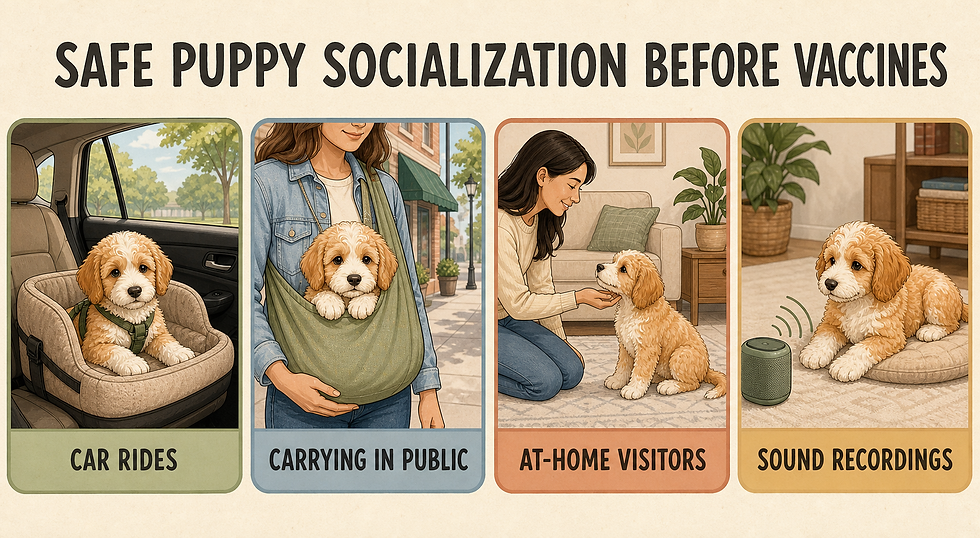
Carry or use a stroller/sling in public spaces like pet-friendly stores, so your puppy can see and hear the world without touching high-traffic ground
Invite healthy, fully vaccinated adult dogs you know well into your home or yard for supervised, calm exposure
Drive to a busy parking lot or shopping center and sit in the car with your puppy, watching people, cars, and activity from a safe distance
Practice sound desensitization at home — play recordings of thunderstorms, traffic, vacuums, or doorbells at low volume, gradually increasing as your puppy stays relaxed
Host visitors at home so your puppy meets a variety of people (different ages, hats, glasses, mobility aids) in a controlled setting
Threshold Training: Socializing From a Safe Distance
"Threshold training" simply means finding the distance at which your puppy can observe something new — a busy street, a dog park fence, a construction site — while staying calm.
From that distance, reward calm observation, and only move closer as your puppy's body language stays relaxed (loose body, ears up, curious rather than frozen or trembling).
This approach lets your puppy experience an enormous amount of the world safely, without needing direct contact with unknown dogs or high-traffic surfaces before their vaccine series is complete.
Understanding the First Fear Period
Right in the middle of the socialization window, most puppies go through a "fear period" around 8–12 weeks, where previously neutral things can suddenly seem scary.
During this stage, avoid forcing interactions or flooding your puppy with new experiences — let them set the pace, offering distance and choice rather than pushing forward. A second, less commonly known fear period can also appear around 6–8 months, and the same patient, distance-based approach applies.
What If My Puppy Missed Part of the Socialization Window?
If your puppy came from a shelter, was rehomed, or simply missed early socialization opportunities, don't panic — the window doesn't slam shut, it just narrows.
Older puppies and adult dogs can absolutely still learn to feel comfortable with new experiences; it typically just requires more patience, smaller steps, and more repetition than it would have during the ideal window.
Talk to Your Vet About Your Puppy's Specific Timeline
Every veterinarian has slightly different guidance depending on regional disease risk, your puppy's specific vaccine schedule, and their individual health history — always confirm your puppy's timeline for outdoor exposure with your vet rather than relying on a one-size-fits-all rule.
For structured, step-by-step socialization exercises designed specifically for the pre-vaccine window — including threshold training scripts and sound desensitization plans — Doodling All Day recommends the Baxter & Bella training program, the same resource we recommend to every one of our puppy families.
Use code DOODLINGALLDAY for 25% off lifetime training packages.

Frequently Asked Questions About Puppy Socialization Before Vaccines
When can puppies go outside before they're fully vaccinated?
Puppies can typically go outside in low-risk areas — your own yard, a carried position in public, or a car ride to observe from a distance — well before full vaccination, as long as they avoid direct contact with unknown dogs or high-traffic ground where disease exposure risk is higher. Always confirm specifics with your veterinarian.
Is it safe to socialize a puppy before their vaccine series is complete?
Yes, with the right precautions. Socialization doesn't require nose-to-nose contact with unfamiliar dogs — carrying your puppy in public, hosting known vaccinated dogs at home, and threshold/distance-based exposure all provide meaningful socialization with minimal health risk.
What is the puppy socialization window?
The critical socialization window runs roughly from 3–4 weeks old through about 4 months old. This is the period when a puppy's brain is most receptive to learning that new experiences are normal rather than threatening.
What happens if my puppy misses the socialization window?
Socialization becomes more gradual and requires more patience, but it's far from impossible. Even adult dogs with limited early socialization can learn to feel comfortable in new situations with consistent, positive, distance-based exposure over time.
How do I know if my puppy is stressed during a socialization outing?
Watch for trembling, hypervigilance, panting, freezing, or trying to move away — signs it's time to add distance rather than push forward. Comfortable, happy body language typically looks loose and curious, with ears up and a relaxed tail.

Comments